.png?width=2000&height=784&name=Untitled%20design%20(10).png "Mable Therapy Logo")

by Bryony Rust on Sep 6, 2018

Reviewed by the Mable Therapy clinical team: August 2026
With term in full swing, many teachers will be thinking about how they can preparing their classroom for the months ahead.Classrooms are spaces that we spend a lot of time in - and the environments we live and work in can have a huge impact on our engagement and wellbeing.
Whilst some aspects of a classroom are outside our control, there are plenty of simple changes that can make a real difference. Whether you're working around a noisy corridor, an awkward classroom layout or ageing furniture, it's still possible to make small changes to create a communication-friendly classroom that helps every child participate and learn.
Why is a Communication-Friendly Classroom Important?
A communication-friendly classroom encourages children to listen, understand, express themselves and interact confidently with others. These skills are essential for developing vocabulary, building positive relationships, following instructions and achieving academic success. They are especially important for children with speech, language and communication needs (SLCN), but they benefit every learner.
.png?width=613&height=321&name=Blog%20Images%20(16).png)
1. Organise your Space
As an enthusiastic teacher, you likely want to take every opportunity to try out new resources, and hold on to old resources ‘just in case’. But, reducing the clutter in your environment supports good attention. Consider which resources you and the children access regularly, versus which ones may be collecting a bit of dust!
Display boards are great in classrooms, but as the year progresses, they may become overcrowded or perhaps a little bit neglected. Throughout the course of the year, look at the display boards you have on the walls and ask yourself, are they still relevant? When was the last time you referred to them? When was the last time a child benefited from its presence? And could this space be used for a more relevant topic? If it is time to update those display boards, then remember, the more visually interesting a display board is, the more likely it will be to create opportunities for children to share thoughts and ideas!
Likewise, if you also have flexibility in your classroom to do so, perhaps make room to create a cosy and comfortable space for a quiet corner. Some children will really benefit from this, especially those who sometimes feel overwhelmed and anxious by the school day and need a break to self-regulate.
2. Sound
Now we've focussed on organising the classroom space, let's turn our attention to sound.
Some of the most beautiful modern school buildings don’t always allow for good acoustics. High ceilings, hard surfaces and open plan spaces bounce the sound around in a way that puts extra demands on our auditory processing. So, a space needs to be created where sound can be controlled.
.png?width=573&height=300&name=Blog%20Images%20(19).png)
Classrooms should incorporate soft furnishings which help to absorb sounds. For example, use carpets and rugs, rather than having wooden or laminate flooring. You could also use blankets, bean bags and throws to pad out the room. Some classes also make cosy areas using small tents or tipis which provide soft material to absorb the sound. Another idea is bookshelves, these are not only a lovely way to display books in a classroom, but they also give the room more material to reduce echoes.
3. Plan your visual supports
In terms of visuals, 'Question word' charts are a great visual to model questions and prompt children to begin asking their own. And, going back to display boards - these are fantastic whole class visuals and can be good conversation starters. Avoid the pressure to have every board filled up at the beginning of the year. A blank canvas can be a motivating thing to add to collectively over the coming months!
Visuals are also an excellent way to encourage and promote a child’s self-awareness around their emotions and behaviours. Other visuals such as emotional check-ins and emotion charts are great too, and can be really beneficial in developing emotional literacy skills.
Visual timetables for individuals and for the whole class are also another way of creating a communication friendly environment. Visual time-tables will allow children to understand what they are doing throughout the day, and when it is going to happen. It will also reduce those feelings of anxiety and uncertainty that some children experience. Practicing this will help to encourage communication in the classroom as they grow with confidence.
.png?width=613&height=321&name=Blog%20Images%20(20).png)
4. Add Greenery
This one might not immediately come to mind, but there’s a large body of evidence pointing to the benefits of natural environments for social interaction, creative thinking and resilience (much of which is referenced in the book 'Last Child in the Woods'). Of course, this is about more than adding the odd potted plant to the shelf, but even a glimpse of green has been shown to have a positive impact on wellbeing.
.png?width=613&height=321&name=Blog%20Images%20(17).png)
Try having one or two plants in the classroom, and, depending on the age of your pupils, suggest that they take some responsibility in watering the plants every day. Some children will really love this added responsibility!
5. Light
How can you make the most of the natural light in your space? It’s best to avoid having the window behind you when you speak. This can make it hard for children with auditory processing difficulties, hearing loss and visual impairments to read non-verbal cues such as lip movements.
.png?width=613&height=321&name=Blog%20Images%20(18).png)
Natural light has also been found to increase our concentration levels and attention; however, there will be times throughout the year where the natural light may be too bright. This will cause a glare and may make it difficult for children to see. In this case, consider using blinds or muslins to diffuse and soften the light.
You can also play around with lighting to create different moods. For example, fairy lights in cosy areas can create soft lighting, which can help children to relax.
6. Makaton
Makaton is a language programme which uses signs and symbols to help people communicate. Makaton does not replace verbal communication, and it is different to British Sign Language (BSL). The signs are actually used alongside speech, to help people understand the spoken language and express thoughts and feelings.
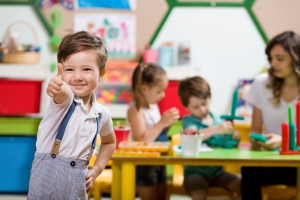
Using Makaton and gestures also has benefits for children with learning disabilities, autism, down syndrome, and those with other speech language and communication needs. The visual nature means that children enjoy participating and copying. This is great for everyone in class, but especially the more reluctant communicators, as it will encourage inclusiveness and acceptance.
A great tip to encourage Makaton across the school is to have a ‘sign of the week’. A visual could be placed around school, so pupils and staff have lots of opportunities to see and practise the sign. The Makaton Charity have lots of great resources and videos for you to learn from too on their website and YouTube channel. They also offer formal training and workshops.
CPD Training with Mable Therapy: Creating a Communication Friendly Classroom
Here at Mable Therapy, we're working to support teaching staff in schools with further developing their knowledge and understanding around speech, language and communication. As part of this, we offer a variety of staff training courses in our 'Mable Academy' - some of which are CPD accredited. The Mable Academy includes our course 'Creating a Communication Friendly Classroom', which explores in detail controlling noise levels in the classroom; using visuals; using Makaton; the role of adults - and more. Explore our suite of Mable Academy courses here.

Top-tips to start using Makaton signing in your classroom
The Link Between Mental Health and Behaviour